LI TEXTILES / A TERMINOLOGY NOTE
A living textile tradition—
beyond “brocade”.
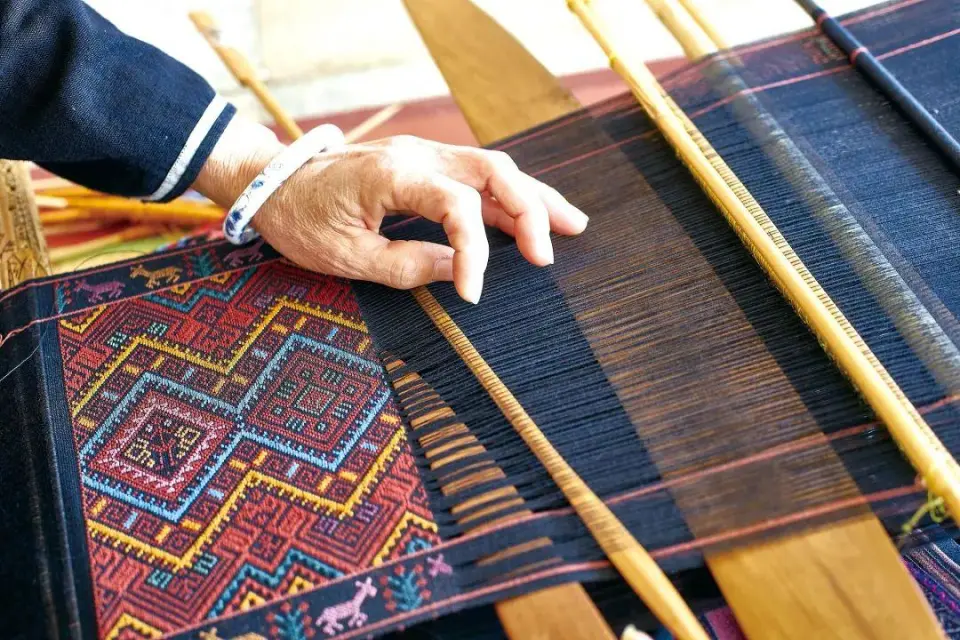
Li textiles are created through a complete system of spinning, dyeing, weaving and embroidering developed and transmitted by Li communities in Hainan, China.
They are sometimes described internationally as “Li brocade”. Lijin Elements uses “Traditional Li textile techniques” for the complete system, and Li textiles or Li textile traditions in shorter contexts. “Brocade” describes only part of a much broader living tradition.
ONE INTERCONNECTED SYSTEM
Four practices.
Knowledge held together.
- 01
Spinning
Preparing fibres and forming thread—the material beginning of the textile.
- 02
Dyeing
Building colour through local materials, preparation and accumulated experience.
- 03
Weaving
Coordinating body, tools, tension and thread selection to create structure and pattern.
- 04
Embroidering
Constructing imagery and surface through stitches guided by memory and judgement.
CULTURAL CONTEXT
Technique, material and cultural memory.
The tradition is not a single fabric type or a fixed catalogue of motifs. Materials, structures, colour, tools and ways of making vary across communities and individual makers.
UNESCO identifies the tradition as “Traditional Li textile techniques: spinning, dyeing, weaving and embroidering”. This language recognises a connected body of knowledge rather than reducing it to a decorative surface.
OUR LANGUAGE
The words we use shape what can be understood.
- Traditional Li textile techniques
- The complete system of spinning, dyeing, weaving and embroidering.
- Li textile traditions
- The living cultural knowledge, practices and transmission surrounding the textiles.
- Li textiles
- The concise term we use for the textiles and their broader material practice.
- “Li brocade”
- An established search term and translation we acknowledge for clarity, but do not use as our principal term.
READ THE TEXTILES